
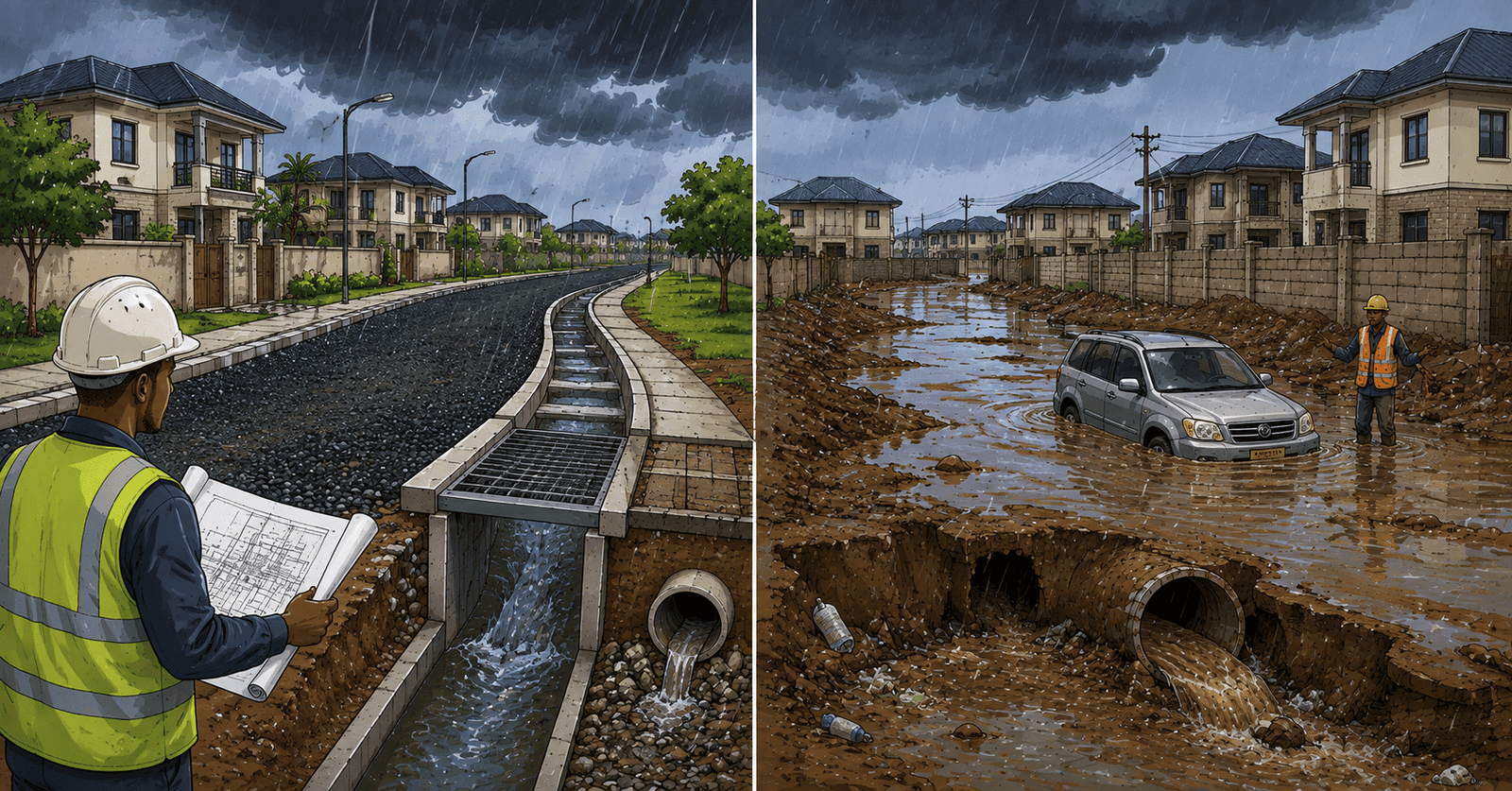
Buyers walk the show unit, check the finishes, and picture themselves in the house. Nobody walks the storm-water culverts. But roads and drainage are the groundwork that decides, years later, whether an estate stays dry through the rains or turns into a maintenance nightmare with standing water at every gate. This is why those civil works belong in the budget from day one, not as an afterthought once the houses are up.
The Groundwork Nobody Budgets For
Civil works are the least glamorous line item on a development budget, and the easiest to trim under cost pressure. Nobody sells a plot on the strength of its storm-water design. But every estate that floods, cracks its access roads, or loses driveways to erosion within a few seasons is usually tracing the problem back to the same place: roads and drainage that were scoped to meet the minimum, not the site’s actual conditions.
Why Roads Come Before Anything Else
Setting Out Levels and Falls Correctly
Roads aren’t just surfaces, they’re the primary channel that moves water off a site. Getting the levels and falls right at design stage determines whether rainwater drains toward the storm-water system or pools against plot boundaries and building lines. This has to be settled before roads are formed, because correcting a road’s fall after it’s built usually means rebuilding it.
Road Base and Sub-Base: Where Corners Get Cut
A road that looks finished on day one can fail within two rainy seasons if the sub-base wasn’t compacted to spec or the base material was thinned to save cost. Once water gets under a road surface that wasn’t properly built up, it undermines the structure from below, and by the time cracking and potholing show on the surface, the damage is already done underneath.
Storm-Water Drainage: The System You Only Notice When It Fails
Sizing Drainage for the Catchment, Not Just the Plot
A common mistake is designing drainage for the estate’s own footprint and ignoring the wider catchment feeding into it, water arriving from higher ground, neighbouring parcels, or an undersized public system downstream. Drainage sized only for what falls directly on the estate will be overwhelmed the first time it also has to carry water from everywhere around it.
Where the Water Actually Goes
Every drainage design has to answer one question concretely: where does the water end up? “Away from the houses” isn’t an answer, it needs a defined path, sized correctly, all the way to a natural watercourse or the public system.
On-Site Attenuation
On larger or flatter sites, attenuation ponds or tanks hold peak storm flow back and release it gradually, rather than sending the full volume downstream at once. This protects both the estate and whatever the drainage connects to further along.
Connecting to Public or Natural Drainage
Where an estate discharges into county storm drains or a natural watercourse, that connection needs to be checked for capacity before it’s relied on. A well-designed on-site system that empties into an undersized public drain still floods, just slightly further downstream, and often on someone else’s boundary.
What Happens When Roads and Drainage Are an Afterthought
Flooded Plots and Damaged Foundations
Standing water against a foundation, even intermittently, is one of the more common causes of long-term structural problems in estate housing, damp, cracking, and soil movement under footings. Once houses are occupied, fixing the drainage that should have handled this from the start becomes a far more disruptive, far more expensive exercise.
Road Failure Under Traffic Load
Roads built to a lower spec than the traffic they eventually carry, delivery trucks, moving vans, daily commuting, deteriorate fast once water gets involved. What looked like an acceptable saving at construction stage turns into a recurring maintenance bill for the estate’s management for years afterward.
Budgeting Civil Works From Day One
What Should Be in the Initial Cost Plan
Roads, storm-water drainage, and the earthworks that set correct levels need to be priced properly at the feasibility stage, alongside the houses themselves, not squeezed in after the housing budget is fixed. That includes ground investigation to understand how the site actually behaves in heavy rain, not just how it looks on a dry-season site visit.
The Cost of Retrofitting Drainage Later
Adding proper drainage to an estate after roads and houses are built almost always costs more than doing it right the first time, it means digging up finished roads, working around occupied plots, and redesigning around constraints that didn’t exist before construction. The budget saved upfront is rarely the budget spent later.
What We Check Before Breaking Ground on an Estate
Before civil works start, we confirm the site’s natural drainage patterns and catchment, set road levels and falls against those patterns rather than a flat design, size storm-water infrastructure for worst-case flow rather than an average, and identify exactly where discharge water will go and confirm that route has the capacity to take it.
A Roads-and-Drainage Checklist for Developers
Before finalising a development budget, confirm:
- Road levels and falls have been set against the site’s actual drainage pattern
- Sub-base and base construction are specified and inspected, not assumed
- Storm-water drainage is sized for the full catchment, not just the estate footprint
- The final discharge point, public drain or watercourse, has confirmed capacity
- Attenuation is considered where the site is flat or the downstream system is limited
- Civil works are priced into the feasibility budget alongside the housing units
- Ground investigation reflects wet-season conditions, not just a dry-season survey
The Bottom Line
An estate is only as good as the ground it sits on and the water it can move away from itself. Roads and drainage are the groundwork buyers never see until it fails, which is exactly why they belong in the budget from day one, priced and designed properly, rather than treated as the line item to trim when costs run tight.