
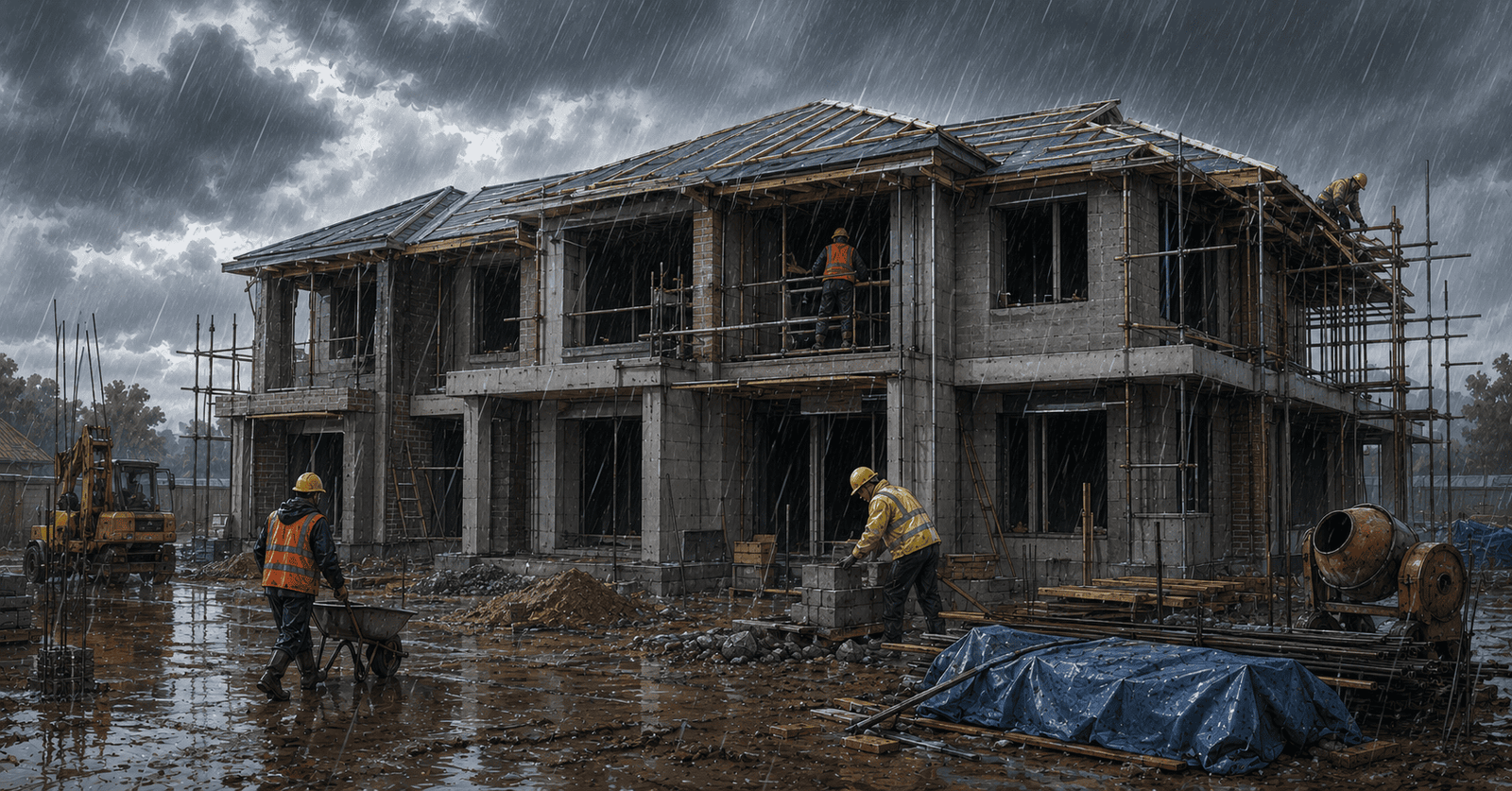
You cannot pause the long rains, but you can plan around them. Every rainy-season construction programme lives or dies on sequencing, the order you pour, roof, and move materials in determines whether the wet months cost you weeks or barely register. Here’s how we sequence pours, roofing, and site access to keep a build moving through the rains.
Why Sequencing Matters More Than Speed in the Wet Months
The instinct in bad weather is to push harder. The better instinct is to reorder the work. A programme that races to keep pace with a dry-season schedule during the rains just produces rework, washed-out pours, delayed curing, waterlogged access roads. Sequencing means deciding what absolutely must happen before the rains intensify, what can shift, and what should wait entirely. Get that order right, and the rain becomes a scheduling constraint, not a crisis.
Read the Calendar Before You Read the Weather
Kenya’s Long Rains and Short Rains
Kenya typically sees long rains from March to May and short rains from October to December, though intensity varies by region and year. A programme built without these windows in mind is a programme that will be rewritten mid-project. We map the anticipated wet periods against the build programme before the first excavation, not after the first downpour.
Building a Rain-Aware Programme, Not Just a Programme
This means front-loading the work that rain disrupts most, earthworks, foundations, and roofing, into the driest windows available, and pushing rain-tolerant work (internal finishes, fit-out, services) into the wettest stretches. It sounds obvious. It’s also the step most programmes skip under pressure to start immediately.
Phasing Concrete Pours Around the Rain
Foundations and Substructure First
We prioritise getting foundations and substructure concrete in before the rains peak. Once the structure is up out of the ground, standing water and saturated soil become far less disruptive to the work above it. Substructure poured into waterlogged excavations is a common cause of foundation defects, so this sequencing decision alone prevents a lot of downstream cost.
Curing Without a Downpour Undoing It
Fresh concrete needs controlled moisture, not an uncontrolled downpour in the first hours after a pour. Rain on unset concrete can wash out cement paste from the surface and weaken it. This is where day-to-day sequencing decisions matter as much as the overall programme.
Covering and Protecting Fresh Concrete
Every pour scheduled during the wet months has protective sheeting on standby, not on order. We cover fresh concrete immediately after finishing and keep it covered until it’s set enough to withstand rainfall, adjusting timing based on the forecast rather than a fixed schedule.
Adjusting Pour Timing Within the Day
Where the forecast allows, we schedule pours for early morning, aiming to get several hours of set time in before afternoon rain, a common pattern in Kenya’s wet season. Where rain is unpredictable, we pour in smaller sections rather than one large pour, so a sudden downpour interrupts less work.
Getting the Roof On Before the Rains Peak
Why Roofing Is the Priority Milestone
Once the roof structure and covering are on, everything beneath it, blockwork, plastering, electrical first-fix, floor screeds, becomes far less exposed to the weather. That’s why roofing sits near the top of our wet-season sequencing priorities, often pulled forward ahead of secondary works that would normally run in parallel.
Sequencing Roof Structure vs Roof Covering
We try not to leave a roof structure exposed and uncovered for longer than necessary. Where the full roof covering can’t go on immediately, temporary sheeting protects the structure and whatever’s below it until the permanent covering is installed. Leaving timber trusses or steel exposed to repeated wetting through an entire rainy season invites problems that show up much later.
Site Access: The Quiet Killer of Wet-Season Programmes
Access Roads and Hardstanding
More rainy-season delays come from trucks that can’t reach the site than from the weather stopping work outright. We assess site access before the rains and put in temporary hardstanding, gravel, or compacted access tracks wherever the natural ground turns to mud under vehicle loads. It’s a small upfront cost against the alternative of a stalled delivery schedule.
Material Deliveries and Storage
We schedule bulk deliveries of cement, timber, and anything moisture-sensitive for the drier stretches within the wet season, and store them off the ground and under cover on arrival. Materials sitting in the open during the long rains are one of the most avoidable causes of wastage on a site.
Drainage and Site Protection While You Work
Temporary drainage, cut channels, sump pits, silt traps, goes in before the rains, not after the first flooded excavation. We keep excavations pumped and graded to shed water rather than collect it, and we protect stockpiled materials and open trenches with the same attention we give the structural work itself. A site that manages its own water well loses far fewer working days than one reacting to it.
What We Do Differently on Site During the Rains
In practice, this means daily forecast checks feeding into next-day sequencing decisions, protective materials kept on site rather than ordered when needed, a programme that’s been pre-sequenced around the wet months rather than adjusted reactively, and a site team briefed on which activities pause and which continue when rain starts. None of this is complicated, it just has to be decided in advance.
A Simple Wet-Season Sequencing Checklist
Before the rains set in, confirm:
- Foundations and substructure are prioritised ahead of the wettest weeks
- Protective sheeting is on site and ready before every pour, not ordered after
- Roofing is sequenced as an early milestone, with temporary cover for any gap
- Access roads and hardstanding can take truck loads once the ground is wet
- Deliveries of moisture-sensitive materials are timed and stored under cover
- Temporary drainage is in place before excavations open, not after they flood
- The site team knows in advance which activities pause in heavy rain
The Bottom Line
The long rains aren’t a reason to pause a build, they’re a reason to sequence it differently. Prioritise foundations and roofing ahead of the wettest weeks, protect every pour before it happens rather than after, secure site access early, and manage drainage as carefully as the structure itself. Done right, the rain becomes one more variable in the programme, not the thing that decides it.