A complete family home on one level, the most straightforward and cost-efficient way to build.
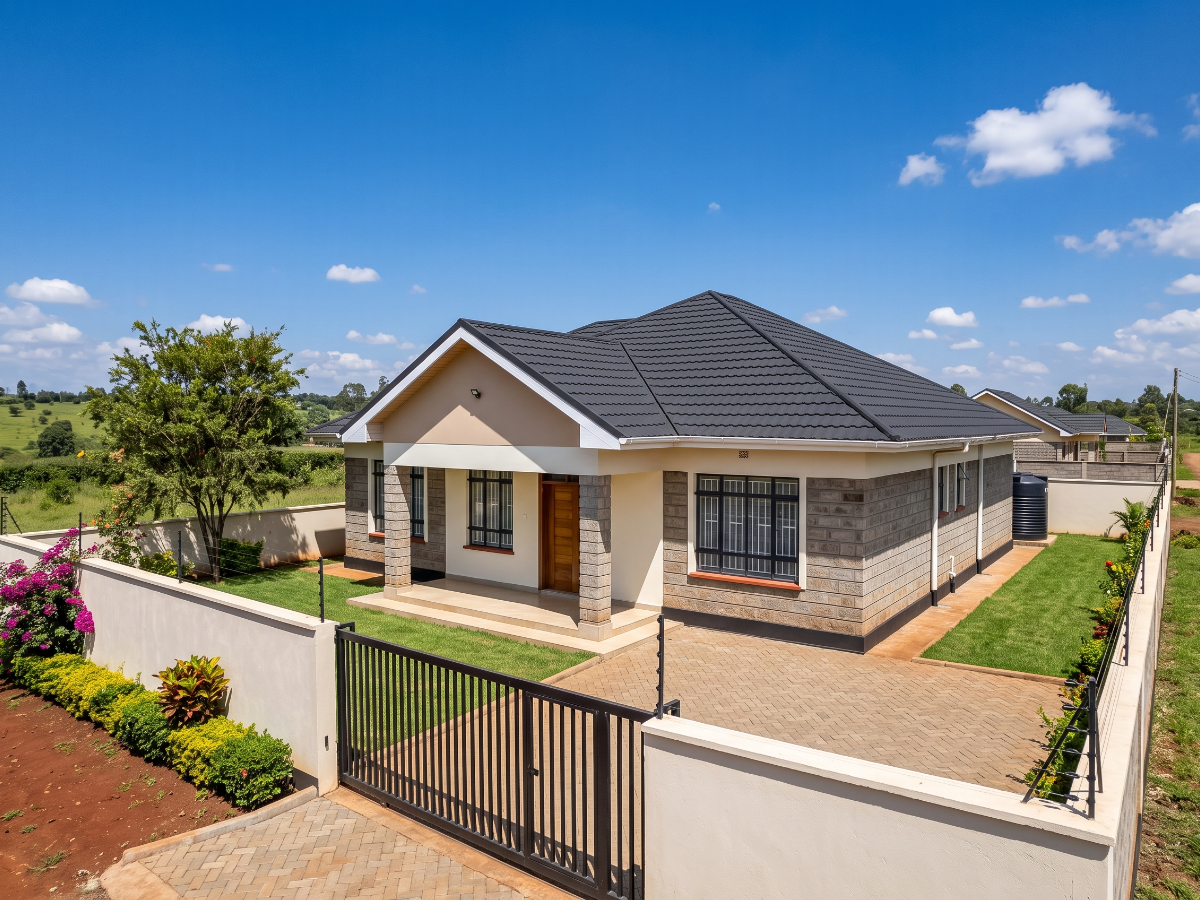
A bungalow is a single-storey house. Every room sits on one level, with no staircase and no upper floor. It is the most direct form of house construction there is, and for many families it is the first home they build.
First-time builders who want to get onto their land without overcomplicating the project. Families building outside the city where land is affordable enough to spread out. Older homeowners and anyone who would rather not live with stairs. Landowners building a single rental unit that will be easy to let and easy to maintain.
Two, three and four-bedroom layouts, with three bedrooms being the most commonly built. Plans are typically rectangular or L-shaped, with the L used to create a sheltered veranda or an internal courtyard. Most include a master ensuite with the remaining bedrooms sharing a bathroom, and many are built with a detached staff quarters at the rear of the plot.
A single continuous floor level throughout. A hipped or gabled roof covering the entire footprint. A covered veranda or entrance porch, which is standard on almost every Kenyan bungalow and does real work in both sun and rain. An attached or freestanding carport. All plumbing and drainage runs at one level, which keeps the services layout simple.
A bungalow is the least expensive house type to build per square metre, because it has no staircase, no suspended floor slab and a simpler structural frame. It goes up faster than a two-storey house of the same size. It is easy to extend sideways later if the plot allows, so you can build three bedrooms now and add two more in a few years. Maintenance is straightforward, you can reach the roof, the gutters and the external walls without scaffolding. And for households with young children or elderly members, everything being on one level is a genuine daily advantage rather than a design preference.
A bungalow uses more land than any other house type for the same floor area, so it only makes sense where land is reasonably priced. Because the roof covers the whole footprint, the roof is a larger share of the total cost than it would be on a two-storey house, and the same is true of the foundation. That makes ground conditions unusually important here. You also get less privacy from the road and from neighbours than an elevated house provides.
On a bungalow, your money is in the ground and on the roof, not in the walls. Because the foundation and the roof both cover the full floor area, soil conditions affect a bungalow's cost more than they affect a maisonette's. Before you settle on a design, get a soil investigation done. Black cotton soil is widespread across Kitengela, Athi River, Ruai and parts of Kiambu, and it changes the foundation solution and the budget significantly. Finding that out before the design is fixed is inexpensive. Finding it out after excavation has started is not.